



Best Sim Racing Rig in Australia 2026: From Beginner to Pro
|
|
Your sim racing rig is the most important purchase decision you’ll make — more important than your wheelbase, your pedals, or your steering wheel. A $1,000 direct drive wheelbase bolted to a flexing desk wastes most of its potential. A proper sim racing cockpit transfers force feedback directly to your body, eliminates platform movement, locks your pedals in a consistent position lap after lap, and makes long sessions genuinely comfortable. Get the rig right first, and everything else performs better.
This guide covers everything Australian sim racers need to know about choosing a sim racing rig in 2026 — rig types, what to look for, space requirements, and our recommendations at every budget from the GGD showroom in Dandenong South.
One of the most common mistakes we see at Gamer Gear Direct is customers who underestimate rigidity and try to go too cheap on a rig. They start with a budget option, quickly discover it can’t handle the forces their wheelbase generates, and end up upgrading anyway — spending more in total than if they’d bought the right rig from the start.
The logic applies at every level. An entry-level gear or belt-driven wheel on a flexible stand won’t expose the rig’s limitations much. But the moment you introduce a direct drive wheelbase generating 5.5Nm, 9Nm or 11Nm of torque, a flexy rig starts working against you. Force feedback energy that should be communicating what the car is doing instead disappears into chassis flex. Pedals shift position under hard braking. Your body moves when the wheel resists.
The rule is simple: buy as much rig as your budget and space allow. You’ll upgrade your wheel multiple times. A great rig lasts decades.
A wheel stand is the entry point — a compact, folding frame that holds your wheel and pedals without a seat, designed to pair with your existing chair. They’re affordable, pack away easily, and get you racing without committing to a dedicated sim space. The trade-offs are real though: limited rigidity, no consistent seating position, and they quickly feel like a limitation once you’re investing in better hardware.
Steel tube cockpits are a step up — a full seating position with wheel mount, pedal plate and seat frame built from heavy steel tube. They arrive near-complete, assemble quickly, and handle direct drive wheelbases well at the mid-range. The limitation is modularity: harder to reconfigure, and at very high torque levels (25Nm+) they can exhibit more flex than aluminium alternatives.
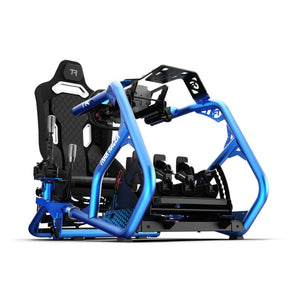
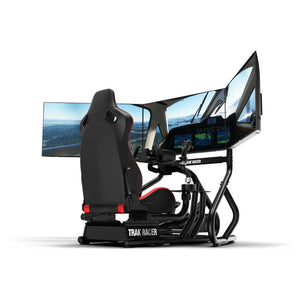
Aluminium extrusion rigs are the gold standard for serious sim racers. Built from T-slot aluminium profile, they offer exceptional rigidity at any torque level, infinite adjustability, and full modularity. You can add monitor mounts, button box plates, handbrake mounts and other accessories anywhere along the profile without drilling or welding. Trak Racer’s aluminium profile lineup is what we stock and recommend at Gamer Gear Direct.

Rigidity is everything in a sim racing rig. A flexy rig wastes the force feedback your wheelbase generates, shifts your pedal position under braking, and limits your lap time consistency. Rig flex becomes a real problem once you’re running high-end direct drive wheelbases. Match your rig’s rigidity to your wheelbase — entry-level direct drive like the MOZA R5 (5.5Nm) is manageable on a mid-range rig, but 9Nm and above demands an aluminium profile cockpit.
A well-fitting sim rig isn’t a luxury — it’s performance. Seating position, wheel height, pedal distance and seat angle all affect how accurately you can apply inputs. Look for full adjustability across all four dimensions so you can dial in your position precisely and replicate it consistently.
We recommend a minimum of 2m x 2m of dedicated space for a sim racing cockpit. That allows room for the rig itself, comfortable ingress and egress, and space for peripherals. Triple monitor setups will need more depth. Measure your room before committing to a rig.
Not all rigs are built equally for direct drive. Most quality aluminium profile rigs handle direct drive wheelbases up to 25Nm and beyond without flex. Check that the wheel mounting plate is rated for your wheelbase’s torque output, and that pedal plate rigidity matches your pedal set — load cell pedals apply significant braking force that a weak pedal plate will transmit as unwanted movement.
Set your rig budget as at least 30% of your overall sim racing spend. The rig is the foundation everything else builds on. Spending $2,000 on a direct drive wheelbase and $300 on a rig is a common imbalance that limits the return on your wheelbase investment.

The Racing Simulator Package Stage 1 is the entry point for sim racers making the jump from a desk or wheel stand to a proper dedicated cockpit. It gives you everything in one package — rig, seat and mounting hardware — ready to set up and race. Stage 1 is for entry-level upgrades: customers who want to get into a proper sim racing position without a large investment, or those early in their sim racing journey who want to experience what a real cockpit setup feels like before committing to higher-end hardware.

The Trak Racer TR80S is the rig we point most serious sim racers toward. It’s a full aluminium profile cockpit — fully adjustable, rigid enough for mid to high-end direct drive wheelbases, and built with quality that means you won’t be looking at an upgrade for years. The TR80S is a great mid-level option. For the vast majority of sim racers in Australia — whether they’re running an R5, R9, RS50 or G PRO — the TR80S is the right rig.

The Racing Simulator Package Stage 2 takes everything up a level — better components, better hardware, a more complete setup out of the box. If you want to turn up the quality of components versus Stage 1, Stage 2 is the move. It’s ideal for sim racers who know they want a higher-quality experience from day one, or those coming in with a clear idea of the level they want to race at.

The Trak Racer TR160 is the strongest, flex-free rig in the GGD lineup. If you want the absolute top of the aluminium profile range — maximum rigidity, maximum adjustability, future-proofed for any direct drive wheelbase at any torque level — the TR160 is the answer. Go TR160 if you want the strongest, flex-free rig around.
A sim racing rig is a foundation, not a complete setup. Here’s how we think about the full picture at Gamer Gear Direct:
Our complete simulator packages take the guesswork out. Stage 1 and Stage 2 are curated around proven component combinations that work together — starting points you can build on as your sim racing develops.
A sim racing rig (also called a sim racing cockpit or racing simulator cockpit) is a dedicated frame that holds your steering wheel, pedals and seat in a fixed, adjustable position for sim racing. A proper rig provides a consistent seating position, eliminates platform flex under force feedback, and supports the kind of setup serious sim racers need.
We recommend a minimum of 2m x 2m of dedicated space for a sim racing cockpit. This gives you room for the rig, comfortable entry and exit, and space for peripherals. Triple monitor setups will need more depth — measure your space before buying.
A wheel stand is a compact, portable frame for your wheel and pedals that pairs with your existing chair. A sim racing cockpit is a complete seating station — seat, frame, wheel mount and pedal plate in one integrated structure. Cockpits offer significantly more rigidity, consistency and adjustability, and are the right choice for any sim racer using direct drive hardware.
Most quality aluminium profile cockpits handle direct drive wheelbases without issue. The Trak Racer TR80S and TR160 both handle direct drive wheelbases from 5.5Nm through to 25Nm and above. If you’re running a high-end direct drive base, go with the TR160 for maximum rigidity.
Yes — Gamer Gear Direct’s Dandenong South showroom has sim racing rigs set up and running. Visit us to sit in a rig and get advice from our team before making a decision.
For beginners making the jump from a desk, the Racing Simulator Package Stage 1 is the right starting point. If your budget stretches, going straight to the Trak Racer TR80S saves you an upgrade step later.
You can start with a desk and a wheel clamp. But a desk setup limits your seating position consistency, offers no pedal stability, and doesn’t scale well with direct drive hardware. If you’re investing in a direct drive wheelbase, investing in a proper rig at the same time is the smarter call.

Ready to build your setup? Browse our full sim racing rig range at Gamer Gear Direct, or visit our Dandenong South showroom to sit in a rig before you buy.
Written by Karl Matias, Customer Service Specialist at Gamer Gear Direct. With six years of experience across racing and flight simulation, Karl has a well-rounded passion for all things sim and a knack for helping GGD customers find their perfect setup. Whether you’re just starting out or looking to upgrade, Karl’s been there — and probably already has an opinion on your next piece of gear.


