

Truck Simulator Explained: Why Virtual Trucking Is So Addictive
|
|
Ever wondered what it’s like to haul a massive B-double across the Nullarbor, guide a long trailer through a tight depot, or settle into a long highway run after a full day of work?
That's what makes truck simulators fun. It’s about rhythm, control, patience, planning, and the strange satisfaction of completing a job properly.
At Gamer Gear Direct, we’ve tested different setups at our Dandenong showroom and found that truck simulator gaming feels completely different once the controls match the experience. A keyboard can get you started, but a proper wheel, pedals, stable cockpit, and smart screen setup can turn virtual trucking into something far more immersive.
The team here has tested products across racing and driving simulation, and many of the same principles apply to a truck simulator setup. The gear needs to feel stable, the pedals need to respond consistently, and the steering needs to be smooth.
Most importantly, the whole setup needs to stay comfortable during long sessions.
There's something almost meditative about the truck simulator experience. Unlike traditional racing games where you're constantly chasing milliseconds and dodging competitors, this genre invites you to slow down, appreciate the journey, and engage with the subtle complexities of professional trucking.
You might think driving a virtual truck would be boring, but that's exactly what makes it brilliant. What draws players in is the attention to detail, the sense of progression, and the freedom to explore vast, meticulously recreated landscapes at your own pace.
Why do thousands of players spend hours hauling cargo across digital highways? The answer's surprisingly complex:
Escapism with purpose: Unlike aimless wandering, every journey has a goal
Stress relief: The rhythmic nature of long-haul driving can be genuinely relaxing
Achievement: Building your trucking empire from a single contract to a fleet of vehicles
Exploration: Discovering new cities, landmarks, and scenic routes
Community: Sharing experiences with fellow virtual truckers worldwide.
Modern truck simulator games have become far more detailed. The roads feel more believable, the cabins look more complete, and the driving experience rewards smoother inputs.
That extra realism also exposes the limits of basic controls. If you’re playing with a keyboard, steering can feel too sharp. If your pedals slide around, braking becomes inconsistent. If your monitor is too small or too far away, mirror checks and reversing can feel harder than they should.
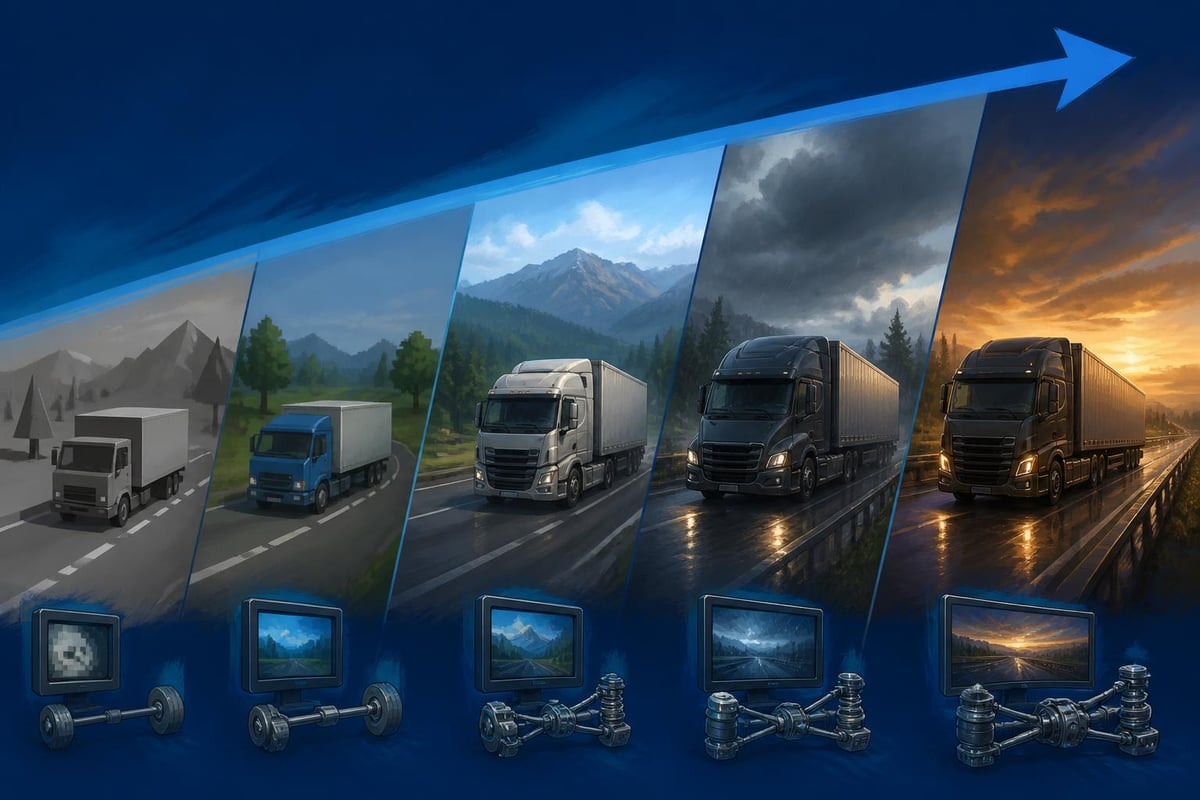
After testing different setup styles, our biggest finding is simple: the first major upgrade should be the controls.
A wheel and pedal set makes the biggest immediate difference to a truck simulator setup. Steering is smoother, braking feels more deliberate, and low-speed manoeuvres are easier to manage. You don’t need to build a full cockpit on day one, but the wheel and pedals are the foundation.
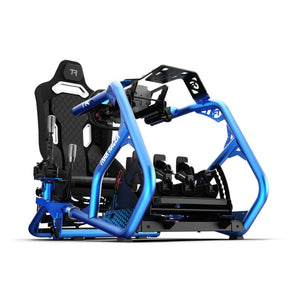
The second major improvement is stability. A desk-mounted wheel can work, but it usually has more movement than a proper wheel stand or cockpit. During long drives, that movement becomes annoying. During reversing or tight parking, it can affect your precision.
The third improvement is comfort. Truck simulation sessions are often longer and slower than racing sessions, so seating position matters. A rigid frame, comfortable seat, and consistent pedal placement make the whole experience easier to enjoy.
For drivers building a serious setup, we’d usually look at racing simulator cockpits, sim racing wheels, sim racing pedals, and sim racing shifters before adding extra accessories.
Those core pieces do the most work.
You can absolutely enjoy truck simulator games with a keyboard and mouse, but if you're serious about the experience, the right hardware makes an enormous difference. Just like how racing simulators benefit from dedicated equipment, truck simulation truly comes alive with proper gear.
The foundation of any truck simulator setup starts with your controls. A quality steering wheel transforms the experience from "playing a game" to "driving a truck."
Key considerations for truck simulation:
Rotation range: Look for wheels offering 900 degrees or more
Force feedback: Essential for feeling road texture and weight transfer
Pedal precision: Linear brake pedals make a massive difference
Build quality: You'll be spending hours at the wheel
Many enthusiasts find that equipment designed for sim racing translates perfectly to truck simulation. The principles remain the same: precision, feedback, and durability.
Here's something that might surprise you: head tracking systems can massively improve your truck simulator experience. Being able to naturally check your mirrors, look over your shoulder while reversing, or scan for traffic simply by moving your head creates incredible immersion.
Professional truck drivers constantly scan their environment, and head tracking lets you replicate that essential behaviour naturally.
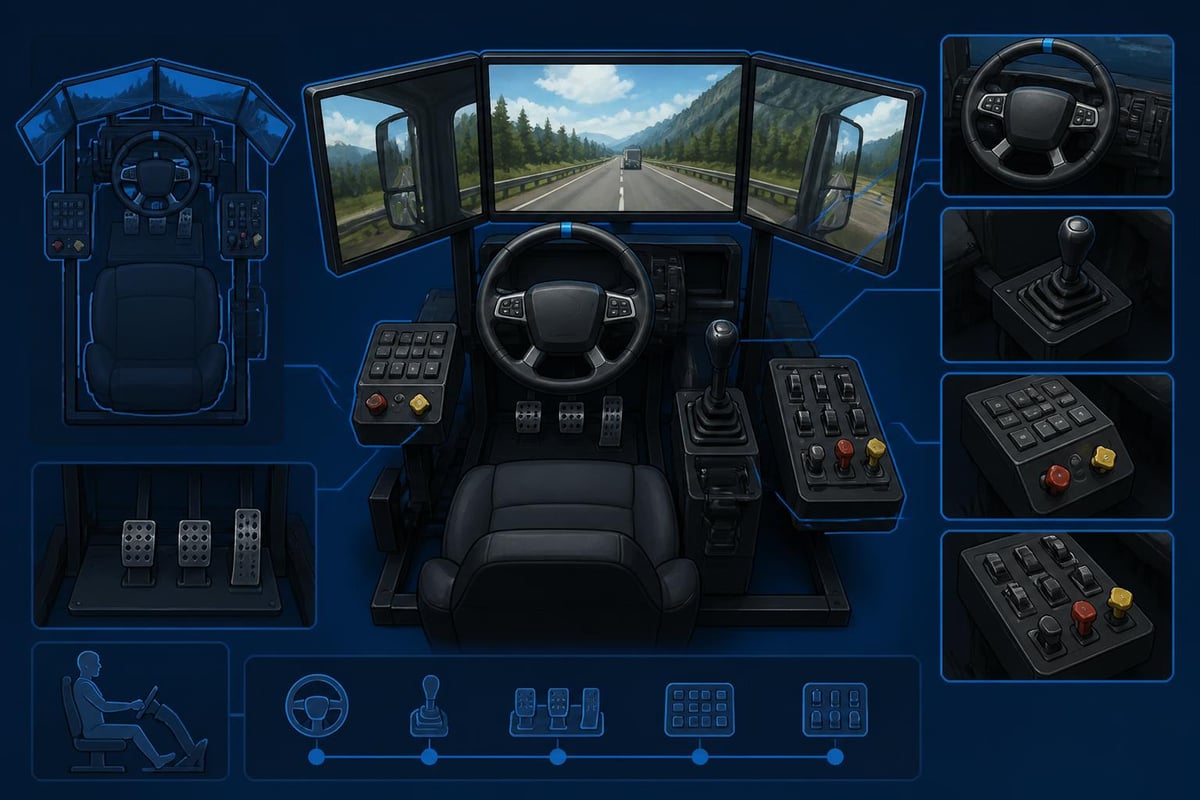
While you can mount your wheel to a desk, a dedicated sim rig provides stability and adjustability that desk clamps simply can't match.
Racing simulator options and dedicated trucking setups share the same core requirements: rigidity, adjustability, and comfort for extended sessions.
Comparison of setup options:
Setup Type |
Pros |
Cons |
Best For |
|---|---|---|---|
Desk Mount |
Affordable, space-efficient |
Limited stability, setup/takedown required |
Casual players |
Foldable Rig |
Good stability, storable |
Assembly time, less rigid than fixed rigs |
Shared spaces |
Fixed Cockpit |
Maximum stability, always ready |
Space requirements, higher cost |
Dedicated enthusiasts |
Custom Build |
Perfectly tailored |
Requires DIY skills, time investment |
Specific needs |
A shifter isn’t essential for every truck simulator driver, but it can add a lot to the experience once your wheel and pedals are sorted.
Manual shifting makes hill starts, heavy loads, and slower manoeuvres feel more involved. It also gives you more control during technical driving, especially when you’re trying to move smoothly rather than quickly.
Button controls can also make a truck simulator setup feel more natural. Mapping functions like indicators, wipers, lights, cruise control, engine brake, camera views, and horn to accessible buttons reduces the need to reach for a keyboard.
This is one of the easiest ways to improve immersion. The more your controls feel like a driving environment, the less the game feels like a normal PC title.
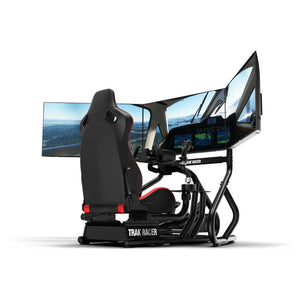
The screen setup can make a major difference to truck simulator immersion.
A single monitor works well for beginners, especially when the wheel and pedals are positioned correctly. Larger displays can make the cabin feel more natural and help with road visibility. Ultrawide and triple monitor setups can improve side visibility, which is useful for intersections, lane changes, and wide trailer turns.
The main thing is positioning. If the monitor is too far away, the cab can feel disconnected from your controls. If it’s too high or too low, long sessions become less comfortable. Getting the screen close to the wheelbase and at a natural eye level can make the whole truck simulator experience feel more convincing.
Getting started with truck simulators is straightforward, but mastering it?
The learning curve rewards patience and attention to detail.
Different cargoes behave differently. Hauling fragile electronics requires smooth inputs and gentle cornering. Heavy machinery? You'll need to plan your routes carefully and respect momentum.
Cargo considerations:
Weight distribution: Affects braking distances and handling characteristics
Fragility ratings: Determines how carefully you must drive
Time sensitivity: Balances speed against safety and fuel economy
Special requirements: Some loads demand specific trailer types or permits
Real-world innovations in trucking technology often find their way into truck simulator games, enhancing authenticity.
Successful virtual trucking isn't just about driving. You're running a business. Smart route planning, fuel management, and understanding toll costs versus time savings create an engaging meta-game beyond the driving itself.
The economic simulation depth varies between titles, but the fundamentals remain consistent: efficient operations lead to higher profits, which fund better trucks and more lucrative contracts.
Here's where truck simulator gaming separates casual players from dedicated enthusiasts. Maneuvering a 16 metre trailer into a tight loading dock while avoiding obstacles tests spatial awareness and patience.
Essential skills to develop:
Mirror usage for tight maneuvers
Understanding swept path and trailer swing
Clutch control for precise positioning
Traffic prediction and defensive driving
Weather adaptation and night driving
If you've mastered techniques from sim racing, you'll find some skills transfer, particularly around vehicle control and situational awareness.
If you’re building your first truck simulator setup, don’t overcomplicate it.
Beginner setup: Start with a wheel and pedal set mounted to a desk or wheel stand. This gives you the biggest improvement without committing to a full cockpit.
Intermediate setup: Add a stable cockpit or stronger wheel stand, then include a shifter for more control and immersion. This is a strong option for players who spend longer sessions in Euro Truck Simulator 2 or American Truck Simulator.
Serious setup: Build around a fixed cockpit, better pedals, a quality wheelbase, shifter, larger display, and head tracking. This gives you the most convincing cab-style experience and makes long-haul driving feel more natural.
If you’re unsure where to start, focus on the part of the experience that annoys you most.
If the steering feels sharp, upgrade the wheel. If braking feels inconsistent, look at pedals. If your setup moves around, upgrade the mount or cockpit.
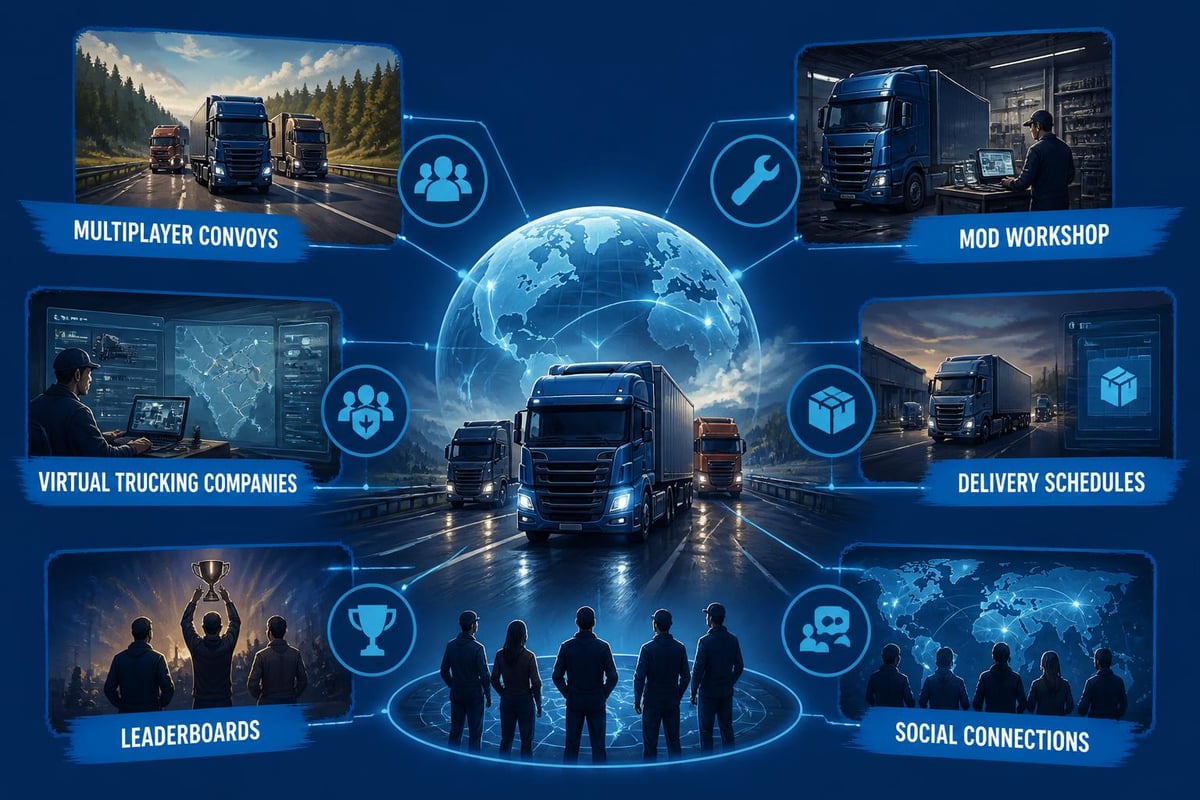
One of the most remarkable aspects of truck simulator gaming is the passionate, supportive community that's grown around it. From convoy events to custom mods, the community adds layers of enjoyment beyond the base game.
Driving alone is peaceful, but joining an organised convoy with dozens of trucks is a different experience. Coordinating with other drivers, maintaining formation, and navigating challenging routes together create memorable experiences.
The social aspect shouldn't be underestimated. Many players have formed lasting friendships through virtual trucking, sharing tips, organising events, and supporting each other's progress.
The modding community for popular truck simulator titles is incredibly active. You'll find:
Custom truck models and liveries
Realistic sound packs
Enhanced graphics and weather mods
New routes and map expansions
Quality-of-life improvements
These modifications let you tailor your truck simulator experience precisely to your preferences, whether that's maximum realism or simply adding your favourite truck manufacturer.
A truck simulator setup is worth it if you want more than casual keyboard driving.
You can enjoy the genre with basic controls, but the experience improves dramatically once the hardware feels stable, smooth, and comfortable.
A good wheel and pedal setup makes driving more natural.
Cockpits improve consistency.
Shifters and head tracking systems add immersion.
A better screen setup makes the road and cabin feel more believable.
After testing different setup styles at our Dandenong showroom, our advice is to start with the controls, then build around stability and comfort.
That’s the path that gives most players the biggest improvement without wasting money on upgrades they don’t need yet.
Recommended progression:
Start with a quality wheel and pedal set: This foundation matters most
Learn basic controls and truck operation: Master the fundamentals
Experiment with different cargo types: Find what you enjoy
Join the community: Connect with experienced drivers
Gradually upgrade your setup: Add peripherals as budget allows
The truck simulator genre offers something genuinely special: a peaceful, engaging, and surprisingly deep experience that stands apart from mainstream gaming.
Whether you're drawn to the meditative qualities of long-haul driving, the challenge of mastering heavy vehicle dynamics, or the satisfaction of building a successful virtual business, there's never been a better time to explore this fascinating world.
If you're ready to enhance your simulation experience with quality gear and expert guidance, Gamer Gear Direct provides everything Australian sim enthusiasts need to create their perfect setup, backed by knowledgeable support and a commitment to helping you find exactly the right equipment for your trucking adventures.