

D-BOX Motion Simulation Explained: The Ultimate Sim Experience
|
|
Have you ever wondered what it would feel like to actually experience every bump, turn, and acceleration in your favourite racing game or flight simulator?
That's exactly what motion simulation technology brings to the table, and D-BOX has become one of the most recognisable names in this space.
Whether you're a sim racing enthusiast pushing lap times at Bathurst or a flight simulation fan navigating turbulence, understanding how motion systems can elevate your setup is crucial.
Let's dive into what makes this technology tick and whether it's the right investment for your simulation rig.
D-BOX motion simulation creates physical movement synchronised with on-screen action, transforming passive viewing or gaming into an active, immersive experience. The system uses actuators that produce precise movements in multiple directions, creating what the industry calls haptic feedback.
Think of it like this: when your virtual race car hits a kerb, the D-BOX system moves your seat to replicate that exact sensation. The technology reads game data in real-time and translates it into physical motion that matches what's happening on screen.
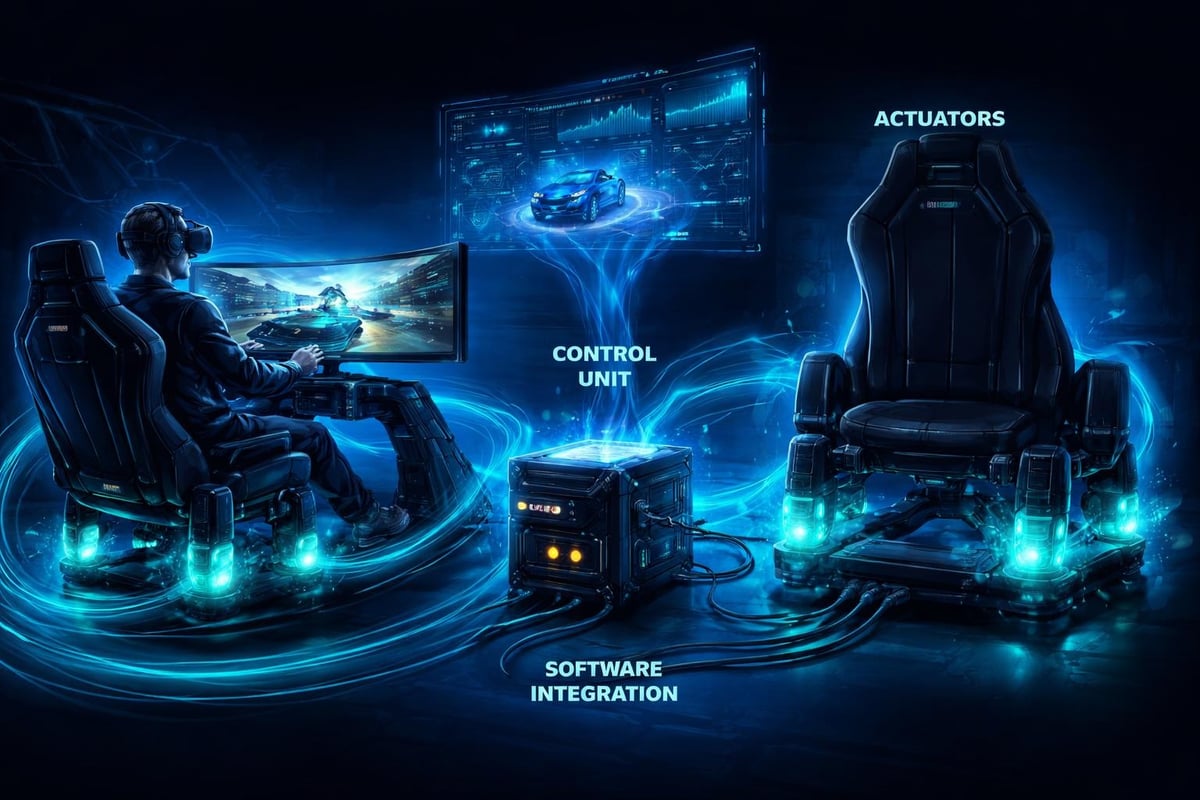
The D-BOX system consists of several key elements working together:
Motion actuators that physically move your seating position
Control unit that processes game data and coordinates movements
Software integration compatible with hundreds of games and simulators
Mounting hardware that connects to your existing rig
What's particularly clever about this approach is the precision. We're not talking about rough, jerky movements that throw you around. The actuators create subtle, refined motions that your body interprets as realistic feedback.
The system operates on three axes of movement, creating what engineers call "degrees of freedom." This allows for pitch (forward and backward tilt), roll (side-to-side tilt), and heave (vertical up-and-down motion). Combined, these movements can simulate everything from the g-forces during hard braking to the sensation of flying through choppy air.
If you've invested time in building the perfect racing simulator setup, you already understand the importance of immersion. Motion systems take this to the next level by adding the physical dimension that other peripherals can't replicate.
When you're hot-lapping around Mount Panorama, the D-BOX platform communicates the weight transfer as you brake into The Chase. You feel the compression as you dive down the hill and the unsettling sensation when the rear steps out under power.
This isn't just about fun, either. Many serious sim racers report improved lap times because the physical feedback helps them find the car's limits more intuitively.
Professional racing teams actually use motion simulation for driver training. The same technology that powers D-BOX consumer systems has roots in these professional applications. Here's what motion adds to your racing experience:
Aspect |
Without Motion |
With D-BOX Motion |
|---|---|---|
Brake points |
Visual cues only |
Physical weight transfer felt |
Oversteer detection |
Steering wheel and audio |
Full body sensation of sliding |
Kerb riding |
Visual bumps |
Physical impact feedback |
Track learning |
Multiple sessions needed |
Faster muscle memory development |
The difference becomes especially apparent in longer racing sessions. Your body naturally responds to the motion cues, making your inputs smoother and more precise. It's the closest you can get to the real thing without actually being trackside.
Flight simulation presents unique challenges that make motion feedback incredibly valuable. When you're piloting a virtual aircraft, you're missing the seat-of-the-pants feeling that real pilots rely on. The D-BOX system bridges this gap by replicating the sensations of flight.
Turbulence becomes tangible rather than just a visual effect. When you bank into a turn, you feel the corresponding roll. Touch down too hard on landing? Your body knows it before your eyes process the bounce. This feedback loop dramatically improves your flying technique.
Consider the approach phase of landing. Real pilots feel the aircraft's attitude through their bodies, making tiny corrections based on physical sensations. With motion simulation, you gain similar awareness:
Stall buffet translates into vibrations you can feel
Crosswind landings create the unsettling lateral movement
Engine torque produces a noticeable roll tendency
Touchdown firmness gives immediate feedback on landing quality
The technology particularly shines when learning instrument flying. Since you're relying on gauges rather than external references, having that physical feedback helps prevent spatial disorientation. Your body maintains awareness of the aircraft's attitude even when your eyes are scanning instruments.
Not all motion platforms are created equal, and the D-BOX ecosystem offers various configurations to match different needs and budgets. Understanding these options helps you make an informed decision about what works for your setup.
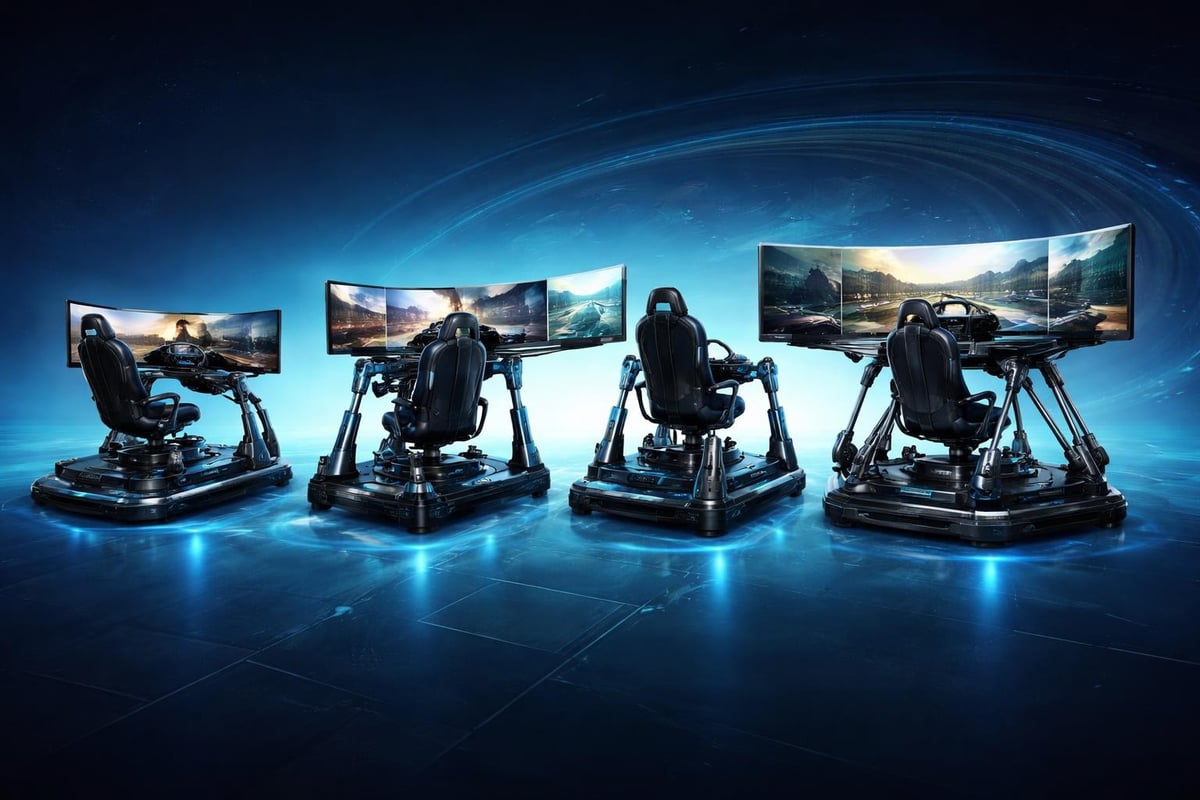
Basic configurations typically use two actuators providing pitch and roll. These work brilliantly for most racing and flying applications, giving you the essential sensations without the premium price tag. You'll feel braking, acceleration, and cornering forces clearly.
Mid-range setups add a third or fourth actuator, increasing the subtlety and range of movements. These systems better replicate complex sensations like combining lateral g-forces with vertical bumps simultaneously.
Professional-grade platforms utilise four or more actuators with extended range and precision. These represent significant investments but deliver the most realistic experience possible outside actual motorsport or aviation.
Here's a practical breakdown of what you might expect:
System Level |
Actuator Count |
Best For |
Typical Features |
|---|---|---|---|
Entry |
2 |
Budget-conscious racers |
Pitch and roll only |
Enthusiast |
3-4 |
Serious sim racers |
Full 3-axis movement |
Professional |
4+ |
Top-tier setups |
Maximum range and precision |
Getting your D-BOX system up and running requires some planning, but it's more straightforward than you might think. The key is ensuring your existing rig can accommodate the additional hardware without major modifications.
Most modern racing and flight sim rigs designed for quality sim racing gear already have the structural rigidity needed. You'll want aluminium extrusion or steel tubing construction, as these materials handle the additional forces without flexing.
Before committing to a motion system, measure your available space. The D-BOX platform needs clearance around your rig for the actuators to move freely. Generally, you're looking at an additional 100-150mm clearance in all directions beyond your static rig footprint.
Measure your current rig dimensions including any protruding elements
Add minimum clearance for actuator movement (check specific model requirements)
Consider cable management for power and data connections
Verify floor surface is level and stable enough to support the weight
Plan access points for maintenance and adjustments
The mounting process typically takes a few hours, depending on your rig's configuration. Most systems come with universal mounting brackets that adapt to various frame types. You'll need basic tools, though nothing specialised beyond what you'd use for normal rig assembly.
One of D-BOX's strengths is extensive software support. The platform works with virtually every major racing and flight simulation title, along with many action games and even movies. The company maintains an active compatibility list that grows regularly.
Racing simulations like iRacing, Assetto Corsa Competizione, and rFactor 2 offer native support, providing the richest motion profiles. These games communicate detailed telemetry data that the D-BOX system translates into nuanced movements.
Flight simulators including Microsoft Flight Simulator 2024, X-Plane 12, and DCS World also integrate seamlessly. Each aircraft type can have custom motion profiles that reflect its unique characteristics. Flying a nimble aerobatic plane feels distinctly different from piloting a heavy airliner.
Configuration flexibility lets you adjust intensity, frequency, and response curves. Some users prefer subtle feedback that hints at what's happening, while others want aggressive movement that really throws them around. The beauty is you can tune it to your preference.
The software updates regularly, adding support for new titles and refining existing profiles. The active user community also shares custom profiles, allowing you to benefit from others' optimisation work.
Like any mechanical system, D-BOX platforms require occasional maintenance to perform optimally. The good news is these systems are engineered for durability, with many users reporting years of trouble-free operation.
The actuators themselves are sealed units requiring minimal intervention. You'll want to:
Keep the moving parts clean and free from dust accumulation
Check mounting bolts periodically for tightness
Update software and firmware when new versions release
Listen for unusual noises that might indicate wear
Most problems users encounter are software-related rather than hardware failures. Game compatibility updates sometimes require profile adjustments, and new title releases might need community-created configurations initially.
Physical issues typically involve loose mounting hardware or cable connections. These are straightforward fixes that any simulation enthusiast can handle. The control units are solid-state electronics with no moving parts, contributing to their longevity.
Warranty coverage varies by model and retailer, but most D-BOX systems come with comprehensive protection for the first year minimum. Extended warranty options often make sense given the investment level.
This is the question every sim racer and flight sim enthusiast asks eventually. The answer depends entirely on your priorities, budget, and how seriously you take your simulations.

For competitive sim racers, the performance advantages can justify the cost. The improved feel for the car's limit translates into faster, more consistent lap times. You're essentially adding a sense that visual and audio feedback alone can't provide.
Flight simulation enthusiasts often find even greater value, as motion feedback addresses one of the biggest gaps between simulation and reality. The ability to feel turbulence, control response, and touchdown quality fundamentally changes the experience.
Consider these factors when weighing your options:
Budget reality: Motion systems represent a significant investment. They cost more than most other simulation peripherals combined. If you're still building your basic setup, prioritising other components might make more sense initially.
Space constraints: You need room not just for the platform itself, but for it to move. Apartment dwellers or those with limited dedicated space might find this challenging.
Usage frequency: If you're logging dozens of hours monthly in your simulator, the cost-per-hour enjoyment factor improves dramatically. Casual users might not extract enough value to justify the expense.
Future-proofing: Motion platforms tend to outlast other components. While you might upgrade your wheel, pedals, or GPU every few years, the motion system typically remains relevant indefinitely.
The technology has matured significantly, and the D-BOX ecosystem offers reliable, well-supported solutions. Prices have gradually become more accessible as the market has grown, though they remain premium products.
While D-BOX dominates mindshare in consumer motion simulation, it's worth understanding the broader landscape. Several manufacturers offer competing systems, each with distinct approaches and price points.
Some platforms use different actuation methods, trading the precision of D-BOX systems for lower entry costs. Others focus on specific use cases, optimising for either racing or flight simulation rather than attempting to serve all markets.
Interestingly, some enthusiasts combine motion platforms with other immersion technologies. Tactile transducers (bass shakers) can complement motion systems by adding high-frequency vibrations that actuators don't replicate well. This layered approach creates remarkably complete sensory feedback.
Wind simulation, heat lamps for cockpit warmth, and even scent systems represent the cutting edge of multi-sensory simulation. While these might sound excessive, they demonstrate how seriously some enthusiasts take immersion.
The key is building your setup incrementally, adding components as budget allows and priorities dictate. Starting with solid fundamentals (a quality rig, good peripherals, and a capable PC) creates the foundation. Motion systems represent the capstone rather than the cornerstone.
Looking ahead, motion simulation continues evolving rapidly. The technology offers capabilities that seemed unrealistic just five years ago, and the trajectory suggests even more exciting developments ahead.
Wireless connectivity is becoming standard, eliminating cable management headaches. Processing power improvements allow more sophisticated motion algorithms that better predict and replicate complex scenarios. Machine learning applications can potentially customise motion profiles to individual preferences automatically.
Integration with virtual reality headsets creates particularly compelling experiences. When your visual perspective and physical sensations align perfectly, your brain accepts the simulation as reality to a remarkable degree. This synergy between technologies represents the future of immersive gaming and training applications.
Cost reduction through manufacturing improvements and market competition should continue making these systems more accessible. What currently sits at the premium end of the market might become mainstream in coming years as adoption grows and production scales increase.
Motion simulation technology like D-BOX transforms simulation from a visual experience into a fully physical one, offering tangible benefits for both enjoyment and performance.
If you're chasing lap records or perfecting your landing technique, adding that kinesthetic dimension creates connections that traditional setups simply can't match.
Gamer Gear Direct offers expert guidance on building the perfect immersive setup tailored to your specific needs, whether you're into racing, flight simulation, or golf. Our team understands the Australian simulation community and can help you navigate the options to find exactly what works for your space, budget, and goals.